Welcome! I've tested and reviewed over 40 different bat detectors here...More than anyone else in the world. I've also started to officially review books about bats & bat acoustics.
Tuesday, September 21, 2021
From Pettersson Elektronik - The USB Ultrasonic Microphones - M500 & U384
Friday, August 20, 2021
Review: The Song Meter Micro Recorder from Wildlife Acoustics Part 2 Of 2
The Song Meter Micro is an unattended recording unit. It's so small and light, that I frequently put it in my pants pocket, before climbing up some steep terrain to deploy it. And, there have been several times (lately) when I've been very thankful for this ability.
In general, it's easy to set-up and deploy. Whenever possible, I try to anchor it to a tree (using a small/short screw) -or- fasten/tether it to a branch, tree trunk, etc. I do this, to prevent the (unlikely) event of an animal walking off with it. Just in case some animal decides it would make a good chew toy?
The Song Meter Micro would be a great choice for Ecologists needing a programmable, unattended wildlife recording solution. The Micro is capable of recording vocalizations from a wide range of species. As mentioned in Part 1 of this review, the sample rate may be changed, to better suit the target species. Admittedly, I've failed to do this myself in the past. For no other reason than being hasty and too anxious to get it set-up before nightfall. Also, from years of using portable digital recorders for wildlife recording: I got into a habit, of always setting the Kbps to whatever the highest setting available was...
Last weekend, right after moving into my new (rental) home, I found myself without a recording bat detector handy. I tend to always keep a Batseeker 4 around; but having a non-recording (FD) detector available just wasn't cutting it. I had a simple digital recorder, but couldn't locate an audio cable (everything was still in boxes).
And while utilizing the latest version of Kaleidoscope Pro software, I was able to get some decent results (when compared to having a dedicated [designed for] bat detector).
But, I digress...
As seen from the screenshot above, the data provided are the most essential factors. The 2 which I typically look at, are: (number of) Recordings, and Battery Level. I'm also happy to report that I've typically been able to communicate with The Micro from distances well on the plus side of 10 meters.
Wednesday, July 28, 2021
Review: The Song Meter Micro Recorder from Wildlife Acoustics Part 1 Of 2
Part 1 Of 2 The Song Meter Micro Recorder from Wildlife Acoustics
The Song Meter Micro, is the latest offering in the line of Wildlife Audio Recorders from Wildlife Acoustics, in Massachusetts USA.
This (very small!) wildlife sound recorder, was developed for those needing to record various (non-bat) animal species.
This compact, cute, and robust sound recorder was designed from "the ground up" to work as an unattended recording solution. The main points one realizes straight away are:
It's small!
It's not very expensive.
It's robust & capable.
Packaging - Upon arrival, you'll notice that the box is small. When you open the (outer) box, you'll notice that the inner box is small...
The unit is 4"/101mm High x 2.9"/74mm Wide x 1.1"/28mm Deep. It is 0.43lbs/195g with batteries installed.
The Song Meter Micro currently sells for $249 (US dollars) directly from the Wildlife Acoustics Site. It is also available from many Dealers in the UK and Europe.
For those in The UK, NHBS has them in stock. The Song Meter Micro is designed for unattended recording of wildlife sounds in the field. It is constructed of a dark green poly-carbonate, which blends into the natural environment very well. It comes with a built-in, omnidirectional microphone. The Song Meter Micro records 16-bit PCM .wav files - to a single, Micro SD card (up to 2 terabytes in size).
The sample rates available, range from 8kHz to 96kHz. 8, 12, 16, 22.5, 24, 32, 44.1, 48, and 96kHz are the selections available. Run time on 3 AA-sized alkaline batteries, is 150 hours. Wildlife Acoustics provides a thorough, 15-step Quick Set-Up Guide.
For a whittled-down version, just to give you an idea of what's involved:
Download/install the free App onto your mobile device.
Get The Song Meter Micro up & running, by installing batteries, Micro SD card, and powering on.
Choose from one of the pre-set schedules provided; save.
Load schedule to The Micro via Bluetooth, replace cover, and deploy unit.
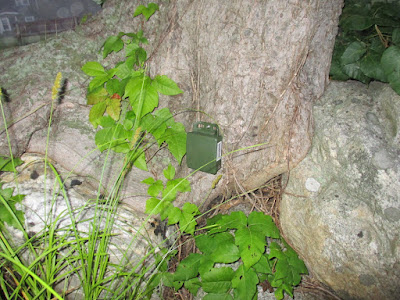
The Song Meter Micro deployed near my local lake. One small screw was all that was needed, to attach it to a tree at the water's edge. My target species here, were small terrestrial mammals (especially Shrews). More specifically, I was hoping to record Northern Short-Tailed Shrew (Blarina brevicauda); which I know to are in the area. No luck yet...at the time of this writing.
Once you read through The Quick Start's 15-Step process, and deploy the unit a few times, it becomes very easy. Read the User Manual, and you'll understand a lot more about how it may be customized: Gain settings, etc.
This unit fills a need for many Researchers working with (non-bat) animals that vocalize.
The unit records sounds very well; about as good as a handheld digital recorder in the same price range. So far, I've recorded various songbirds, ducks, singing insects, and Fowler's Toads.
Part 2 of this review will feature sound recordings (via YouTube video links), as well as spectrograms (using Kaleidoscope, of course!).
When deploying Song Meter Micro's, I would follow this excellent tip, directly from The Wildlife Acoustics's web page: "requires adding desiccant for each deployment to prevent condensation."
Pros:
- Relatively inexpensive for what you get (good value).
- Made by a trusted name in wildlife recording equipment.
- Professional Tech support available.
Cons:
- Mobile device is necessary to control/set-up, and check status.
Once again, The Song Meter Micro may be ordered directly from Wildlife Acoustics, if you're in The U.S.
Links to excellent Song Meter Micro Vimeo videos (created by Wildlife Acoustics):
Song Meter Micro Configuration Editor
Song Meter Micro Configuration Library
Learn more about The Song Meter Micro in Part 2 of 2, of this review.
...Unless, you're the "impatient type" and want to know more about The Song Meter Micro right now - In which case, I'd recommend signing up to The BatAbility Club: Where there's a full webinar (video review) & discussion about it - By yours truly! Along with comments and questions from Director, Neil Middleton.
Happy bat animal detecting!
Wednesday, July 21, 2021
A DIY Ultrasonic Microphone For The AnaBat Walkabout
I've tried making some DIY-type ultrasonic Mics, to plug into The Walkabout's 2.5mm microphone jack... However, there are a few reasons why I wasn't successful. Without going into a bunch of (unnecessary) technical details, suffice it to say that The Walkabout's Mic jack is a bit too advanced to "suffer the foolishness" of my amateur attempts!
The Walkabout's jack provides approx. 6.4 v DC - Not suitable for most DIY Mic capsules, etc. This equated to more tinkering.
Here is just one (of several!) examples, of a (home-built) ultrasonic microphone; which I wired to a (male) 2.5mm plug, for testing with The Walkabout.
The photos below, show a quick wiring-up, for testing. A DIY Mic utilizing the Panasonic WM-61A Mic capsule.
| Quick wiring-up |
| Panasonic WM-61A |
Here is another Mic, which I initially thought would be perfect for The Walkabout. It is an adorable little circuit board (complete with Mic capsule already attached).
| Prior to attaching Arduino-type pins |
| AA battery shown for scale |
These are available from FEL Communications Ltd. (in UK).
In order to get the output voltage of The Walkabout's (2.5mm) jack, to a safe and usable level for the Micbooster Mic board:
I found that a 180K Ohm resistor (on the [+] voltage wire) reduced the voltage from 6.4v to 4.6v - Which is acceptable for the Micbooster ultrasonic board (voltage must be kept below 5v when working with this board).
However, I still had no success in recording any bats through it (attached to The Walkabout). All of my early attempts/tests, with DIY microphones, were unsuccessful.
It was fun trying though. And I was thankful that The Walkabout gives one the opportunity to experiment with such external microphones.
Experiments involving The AnaBat Walkabout have ceased. There is a limit to how much (careful) experimenting I'm wiling to do on a high-end bat detector. Especially one generously loaned to me for testing and review.
I eventually came to the conclusion, that it would be best for someone to just purchase the official Titley microphone adapter and Mic, if there is a need.
In my case, while spending a lot of time trying to build a working Mic:
It only served to bolster my appreciation of the quality recordings captured with The Walkabout's built-in (Knowles) microphone.
But, experiments with this cute little (Micbooster) Mic board continue...
Recent tests, involving the ultrasonic mic board and regular digital recorders seem promising.
Happy bat detecting!
Saturday, July 17, 2021
Some random thoughts on Non-Bat Recorders
As many of you may know, I've been testing and using The Song Meter Micro from Wildlife Acoustics, and I'm impressed.
Of course, as a result, I've become very keen on non-bat sound recording! Amphibians, and singing insects (esp singing insects) had always been a seasonal interest/hobby of mine. And I'd become so accustomed to recording our Spring Peepers each year, that it was all but an automatic reflex.
But as we all know, way-leads-to-way when you're a naturalist: So now, I've become fascinated with rodents and small mammals in their woodland environments:
Voles (some happen to be pretty cute), Moles (very secretive), and especially Shrews! one of my (confirmed) local species of Shrew, is the Northern Short-Tailed Shrew (Blarina brevicauda). Hard to deny that it is one fascinating creature!
I'm fortunate enough, to have a good chance of picking up vocalizations of: Fox, Coyote, and others.
I also remain hopeful, against the odds - that I'll capture vocalizations of a Fisher and River Otter.
Well, there's more interesting tidbits of information, which I'll be adding to this post soon... Including some fascinating projects which Neil Middleton (of The BatAbility Club) and others, are going to be working on: Terrestrial Mammals!
Until then,
Happy bat mammal detecting! ;)
Friday, June 18, 2021
The Song Meter Micro from Wildlife Acoustics - First Look!
I am very happy to report, that The Song Meter Micro from Wildlife Acoustics has arrived for testing and review. So far, I'm very impressed with it.
I couldn't help but make a quick unpacking video.
Let me remind the reader, that this device was designed to record wildlife other than bats. Wildlife Acoustics has it listed as a bird and wildlife recorder (as can be seen from the above link).
This micro-sized unattended recording solution, is already being used successfully in the field - To record singing insects, amphibians, mammals, and birds. It has many customizable features (especially for such a small device).
I simply couldn't resist some preliminary tests with The SM Micro. I've also taken the time to review many of the recordings, made here in the suburbs...And straight away, I can tell this unit has a lot of potential!
I've just recently started to hear singing insects in the evenings. The local population of mammals are pretty much always present. And my local toad and frog population should be making their debut any night now!
Happy bat detecting!
And happy wildlife sound recording! - Visit The Wildlife Sound Recording Society
Review Of The LunaBat DFR-1 Pro Bat Detector Part 2 of 2
- High-pass and low-pass filters
- Full spectrum High Pass filters
- Frequency division high pass filters
As indicated in the user manual when the full spectrum high pass filter is turned on, certain audible sounds will not be recorded, such as those produced at frequencies below 15 kilohertz. Things like conversations, walking on dry grass and / or leaves, and other undesirable sounds.
Use of this filter is recommended during recording attempts in strong winds, or when one is in fact walking on dry leaves, dry grass, etc.
With the full spectrum high pass filter enabled, the lower-frequency limit of recorded signals will be approximately 150 Hertz, which enables things like verbal comments, other voices, and other normally audible sounds.
During my Summer of testing, I rarely came across a situation in which I needed to enable it. When using even the default settings, there weren't many instances where sounds other than bats triggered the LunaBat. I would just hit 'OK' to record, and walk...
If you have dry leaves underfoot during your survey, bat-walk, etc., then in addition to the filter, you can adjust the trigger level. Regardless of the mode I used, no background hiss was heard from this detector.
All of this is covered in more detail in part 3.9 (page 15) of the user manual.
Lasionycteris Noctivagans (Silver-haired bat)
Saturday, April 10, 2021
Review: The LunaBat DFR-1 Bat Detector From Animal Sound Labs - Part 1 Of 2
Review of The LunaBat DFR-1 Pro Bat Detector From Animal Sound Labs
Part 1 of 2 - Hardware, User Manual, and other considerations.
The LunaBat DFR-1, with Non-Illuminated Keys, is priced at 849 Euros.
The DFR-1 Pro bat detector is feature-rich. It has all of the useful features one would find helpful (especially while doing field surveys). And none which might be considered useless, or gimmicky.
- High dynamic range, full-spectrum recording onto standard SD cards.
- Built-in sensors for temperature and humidity.
- Optional built-in GNSS (GPS) with convenient blue LED indicator.
- FD detection for listening through speaker or headphones.
- The (Pro Version) of the detector may also be powered via MicroUSB socket, via an external 5V source, such as a power bank.
- Information displayed on the LCD when the unit is powered up.
- Automatic recording triggered by signal level (performance of this feature is constantly evolving with firmware updates).
Some features I find unique and particularly fascinating are:
- The built-in high voltage generator, which uses 200V to polarize the membrane of optional electrostatic microphones (Model #'s MC-1, MC-2).
- The volume setting is remembered when the unit is powered back on.
- The FD processed signal may be recorded, if one chooses to.
The DFR-1 Pro is very easy to use, straight out of the box. It also has plenty of features to keep you busy customizing it 'till your heart's content. As always, I advise readers to download and peruse the User Manual, available in PDF format (direct link above). It will give a complete account of all features, great and small.
While it boasts Professional-level performance, it also has the appearance of what I've come to refer to as - the quintessential bat detector.
During my extensive testing (Summer 2020) I found The DFR-1 Pro to be a very accurate instrument. Listening to bat calls (live/FD mode) in the field was always a pleasure.
Pros
- Robust design, including microphone and (optional) GNSS module. 3 modules to choose from.
- Excellent sensitivity, and pick-up range.
- Outstanding (384kHz) full spectrum recording quality.
- Frequency division sounds great, and is customizable.
- DFR-1 Pro FS recordings produce excellent spectrograms...
- No live sonograms.
- No proprietary software (as with The Batlogger(s) from Elekon, et al).
The LunaBat DFR-1 Pro may be ordered directly from The Animal Sound Labs website.
For those who like the look and feel of The DFR-1 Pro, I'd like to mention the entry level (affordable) version of The LunaBat: The DFD-1
Looking for The Next Bat Detector for Review!
Well… For now, I’d just like to say Thank You to The Netherlands! 🇳🇱 There will be 2 new bat detectors tested and reviewed here in the ne...
-
Review Of The Echo Meter Touch 2 Pro from Wildlife Acoustics Part 1 Of 2 The Echo Meter Touch 2 Pro , is the latest Android/iPhone-based...
-
The UltraMic Evo 384K USB Microphone from Dodotronic Not to be confused with The UltraMic 250K, or 384K USB microphone, The Evo 384K is a t...
-
The Ranger is a brand, new, cutting edge, wildlife recorder, which has just been released from Titley Scientific. Building upon the success ...


